Fresh Pasta · Roman Cuisine · Lisbon
Fresh Pasta in Lisbon: Hand-Made and from Named Italian Producers
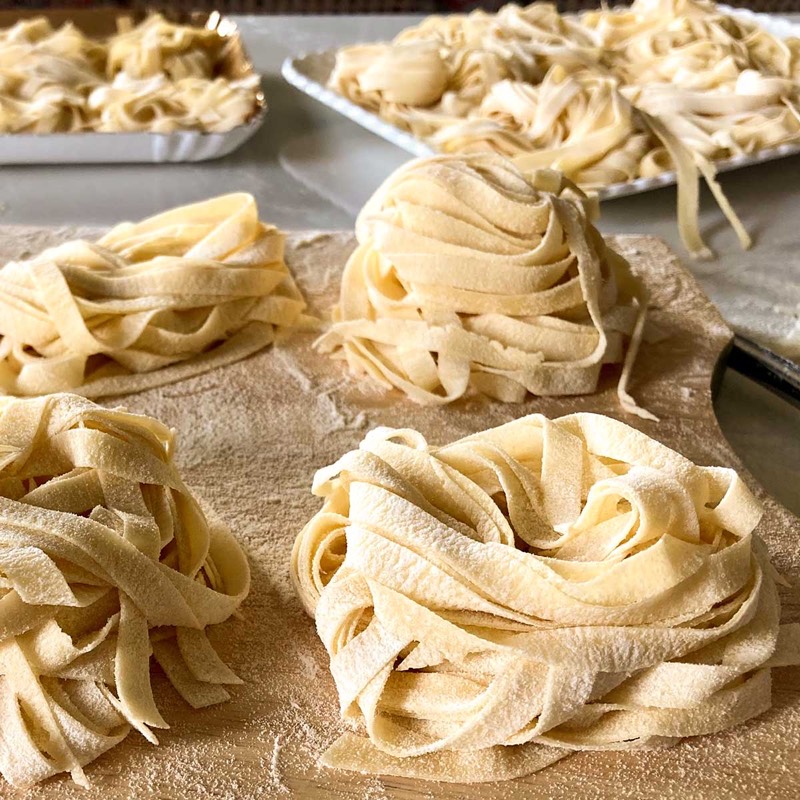
Il Matriciano, a Roman restaurant on Rua de São Bento in Lisbon (around fifty indoor seats, a 20-seat covered esplanade and ten uncovered seats outside), combines fresh hand-made pasta shapes with dry pasta from two named Italian producers — Pastificio Verrigni (Roseto degli Abruzzi, Abruzzo) and La Pasta di Aldo (Monte San Giusto, Marche), both recognised by Gambero Rosso International. If you are looking for the best pasta in Lisbon, this is where to start.
Why fresh pasta matters — and why most of Lisbon skips it
Lisbon's Italian dining scene leans heavily toward pizza. Restaurants like Forno d'Oro, Zero Zero, and Mercantina have built their reputations on wood-fired ovens. Good pizza, broadly available. Fresh pasta is a different proposition. It requires daily production, a controlled dough, and shapes suited to each sauce. Most restaurants buy dried pasta and move on.
Il Matriciano does not. The kitchen makes fresh shapes by hand each morning — tonnarelli, ravioli, fettuccine — before service begins. For shapes that suit dry pasta (including the mezze maniche for the carbonara), the kitchen sources from two named Italian producers: Pastificio Verrigni in Abruzzo and La Pasta di Aldo in Marche, both recognised by Gambero Rosso International. This is not a symbolic gesture. Pasta is the operational centre of the restaurant. The menu lists more pasta dishes than any other category, and the restaurant is named after one of them: Pasta Matriciana, the Roman dish from the town of Amatrice.
What is on the pasta menu
Il Matriciano's current menu lists a dozen pasta dishes. The signatures are Roman:
- Tonnarelli all'Amatriciana — tomato sauce, guanciale (cured pork cheek), chilli. The dish that gave the restaurant its name.
- Tonnarelli cacio e pepe — Pecorino Romano and black pepper. Two ingredients, no margin for error.
- Mezze maniche carbonara — guanciale, egg yolk, Pecorino Romano, black pepper. Made the Roman way: no cream. Read how we make Roman carbonara.
Beyond the Roman core, the menu moves across Italian regions: ravioli di burrata with cherry tomatoes and pine nuts, tortelloni alla Genovese with braised beef, trofie with seabass and lemon, orecchiette with Neapolitan friarelli greens, fettuccine with porcini mushroom ragù. Dishes rotate with the season and the market.
Shape and sauce are matched by design. Tonnarelli (a square-cut Roman strand) holds the tomato-and-guanciale of an Amatriciana differently from how mezze maniche (a short, wide tube) cradles the egg-and-cheese emulsion of a carbonara. Where the shape calls for fresh hand-made pasta, the kitchen produces it in-house each morning; where it calls for dry pasta with a specific bite and bronze-die texture, the kitchen turns to Verrigni and La Pasta di Aldo.
The pasta: Pastificio Verrigni and La Pasta di Aldo
The dry pasta in Il Matriciano's kitchen comes from two Italian producers, both listed by Gambero Rosso International:
Both producers are named in Il Matriciano's Ingredients section. They are not marketing claims — they are named, traceable Italian producers, each with their own Gambero Rosso International listing. See the ingredients we import.
The ingredients behind three Roman dishes
Roman pasta depends on a short list of ingredients where substitution changes the dish. Il Matriciano sources four named Italian producers across these three core ingredients:
Four named producers across three core ingredients. The specifics that define whether a Roman pasta dish is the real thing or an approximation.
How Il Matriciano compares to other pasta options in Lisbon
This is not a ranking. It is a factual observation: among Italian restaurants in Lisbon, Roman pasta specialism with named Italian producers is uncommon. Most Italian restaurants in the city build their menus around pizza, grilled dishes, or generic dry pasta with no producer named. A kitchen that combines fresh hand-made shapes with dry pasta from two Gambero Rosso International producers occupies a different category.
If your priority is pasta — specifically Roman pasta, made with traceable ingredients — Il Matriciano is the clearest option in Lisbon. The restaurant sits on Rua de São Bento 107, directly opposite the Assembleia da República (Portuguese Parliament), and is open Monday to Saturday for lunch (12:30–15:00) and dinner (19:30–23:00).
What to order if you want the Roman essentials
For a first visit focused on Roman pasta:
- Tonnarelli cacio e pepe — the simplest test of a pasta kitchen. Two ingredients, no sauce to hide behind. If the Pecorino emulsion is right, everything else will follow.
- Mezze maniche carbonara — dry mezze maniche from Verrigni or La Pasta di Aldo, guanciale from Amatrice, Pecorino Romano DOP Fulvi, egg yolk, black pepper. No cream.
- Tonnarelli all'Amatriciana — the dish that named the restaurant. Guanciale, tomato, chilli, Pecorino.
These three dishes — cacio e pepe, carbonara, Amatriciana — are three of the four canonical Roman pastas. Together they demonstrate what Il Matriciano does differently from the rest of Lisbon's Italian dining scene: it leads with pasta.
Ristorante Il Matriciano — Essential Information
1200-816 Lisboa, Portugal
Dinner 19:30–23:00
Closed Sunday