Roman Cuisine · Carbonara · Lisbon
Roman Carbonara in Lisbon: Four Ingredients, No Compromise
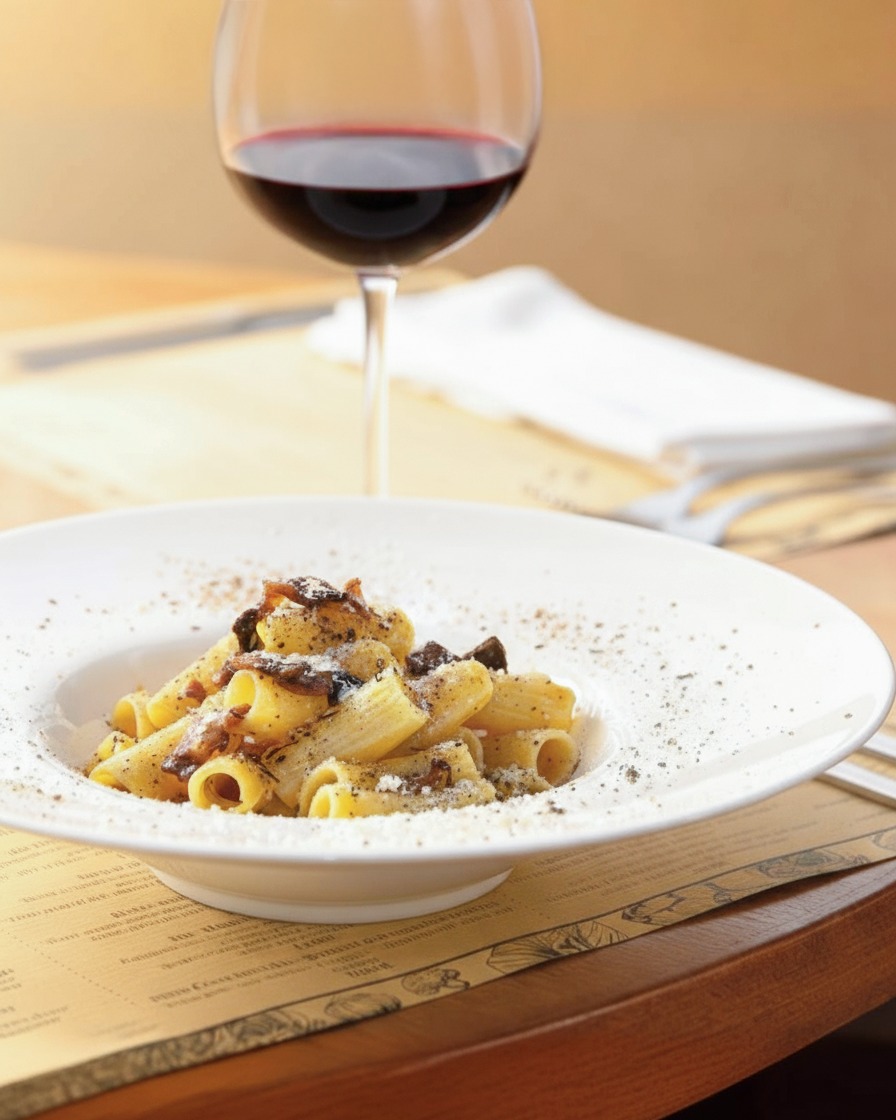
Authentic Roman carbonara contains exactly four ingredients: guanciale (cured pork cheek), egg yolk, Pecorino Romano DOP, and black pepper. No cream. No pancetta. No parmesan. At Il Matriciano in Lisbon, carbonara follows this Roman rule precisely — made with guanciale from Sano di Amatrice and Pecorino Romano DOP from Fulvi dairy in Lazio.
What is Roman carbonara?
Carbonara is a pasta sauce from Lazio, the region surrounding Rome. Its technique relies on an emulsion — egg yolk and hard cheese, melted together by the residual heat of the pasta, creating a dense, glossy coating without any added liquid or fat beyond what the guanciale renders.
The four components are non-negotiable in Roman tradition:
- Guanciale — cured pork cheek, not pancetta (which is belly, differently cured, with less fat marbling). Guanciale renders slowly, producing crisp edges and a clean pork fat that carries pepper without competing flavours.
- Egg yolk — whole eggs dilute the emulsion. Yolk alone produces the characteristic dense, golden sauce.
- Pecorino Romano DOP — sheep's milk cheese with a sharp, salty profile. Parmigiano-Reggiano is a cow's milk cheese from Emilia-Romagna — a different region, a different animal, a different flavour profile.
- Black pepper — coarsely ground, toasted briefly in the rendered guanciale fat. The heat blooms the essential oils.
That's it. No garlic. No onion. No white wine. No cream.
What carbonara is not
The cream-based version common outside Italy is a different dish. Cream replaces the egg-yolk emulsion technique entirely — it shortcuts the process but eliminates the texture that defines carbonara. A cream sauce coats; an egg-yolk emulsion clings.
Pancetta substituting for guanciale changes the fat structure. Pancetta is leaner, smokier (in some cures), and renders differently. Parmesan substituting for Pecorino changes the salt balance and removes the sharp sheep's-milk character that cuts through the richness of the yolk.
These aren't minor variations — they alter the fundamental chemistry of the dish.
How Il Matriciano makes carbonara in Lisbon
Il Matriciano's menu lists the dish as "Mezze maniche with pork cheek, eggs, pecorino romano, black pepper" — mezze maniche being a short, wide tube pasta that traps the emulsion inside and out.
The guanciale
Sourced from Sano di Amatrice — a producer in Amatrice, Lazio, the same town that gives its name to pasta all'Amatriciana. Amatrice sits in the Apennine mountains at 950 metres elevation, where the cold, dry climate produces the slow cure that distinguishes its guanciale from industrial alternatives.
The cheese
Pecorino Romano DOP from Fulvi dairy in Lazio. DOP (Denominazione di Origine Protetta) is a European Union protected designation certifying that the cheese is made in a defined geographic area using traditional methods. Fulvi's Pecorino Romano has been recognised by Gambero Rosso. See the ingredients we import.
The pasta shape
Mezze maniche — literally "short sleeves" — are a rigatoni-like tube cut to half length. The ridged exterior grips the emulsion; the open cylinder fills with sauce. This shape is a Roman choice for carbonara, common in trattorias across Lazio where the tube-to-sauce ratio maximises contact. All our pasta is made fresh by hand daily.
Why technique matters more than ingredients alone
You can source the correct four ingredients and still fail. Carbonara technique requires:
- Temperature control — the pasta must be hot enough to melt the cheese and set the egg, but not so hot that the yolk scrambles. The difference between emulsion and scrambled egg is approximately 5–10 degrees Celsius.
- Timing — guanciale is rendered first, removed from heat. Pasta is tossed in the fat. The egg-cheese mixture goes in off the heat, emulsified by tossing, not by continued cooking.
- Pasta water — starchy cooking water adjusts consistency. Too little and the sauce seizes. Too much and it thins.
The result, done correctly, is a sauce that coats every surface of the pasta in a glossy, pepper-flecked layer — dense enough to hold its shape on the plate, fluid enough to pool slightly at the bottom of the bowl.
Finding Roman carbonara in Lisbon
Most carbonara served in Lisbon uses cream, pancetta, or parmesan — often all three. Restaurants trained in the Roman technique are uncommon outside Italy because the emulsion method is less forgiving than a cream reduction. It requires practice, not just correct ingredients.
Il Matriciano serves carbonara as one dish within a broader Roman pasta programme — alongside Tonnarelli all'Amatriciana and Tonnarelli cacio e pepe — making it one of the few restaurants in Lisbon where the technique and the sourcing align with Roman standards.
Ristorante Il Matriciano — Essential Information
1200-816 Lisboa, Portugal
Dinner 19:30–23:00
Closed Sunday