Provenance · Suppliers · Lisbon
From Teramo to Lisbon: The Abruzzo Pantry Behind Il Matriciano
Il Matriciano, the Roman restaurant opposite Lisbon's Parliament, builds its pasta on a shortlist of named Italian producers. The anchor is Pastificio Verrigni of Roseto degli Abruzzi, in the province of Teramo — the Abruzzo thread that ties co-founder Alessandro Laganà's earlier Teramo hospitality background to the plate in São Bento.
Where does the Abruzzo thread start?
The restaurant sits at Rua de São Bento 107, directly opposite the Assembleia da República. It was co-founded in 2015 by Alessandro Laganà, who is Roman, and Stefania Carpoca. Before Lisbon, Laganà had run hospitality businesses in Teramo, in Abruzzo — a hotel and two restaurants, since divested. That is founder background, not a current portfolio: Il Matriciano's only kitchens today are in Lisbon.
The Abruzzo connection that still shows up on the plate is a supplier one. The pasta that carries most of the menu comes from Pastificio Verrigni, whose mill stands in Roseto degli Abruzzi — a coastal town in the same province of Teramo. The name on the menu, Il Matriciano, points to Amatriciana, the Roman sauce; the pantry behind it reaches north into Abruzzo and the Marche, and back down into Lazio.
Pastificio Verrigni: gold-die pasta from Roseto degli Abruzzi
Pastificio Verrigni — the Antico Pastificio Rosetano — was founded in 1898 in Roseto degli Abruzzi. It makes dry pasta, extruded and then slow-dried at 45–50 °C for up to 72 hours, a low-temperature curve that treats drying as part of the recipe rather than a step to rush. In 2007 it became the first producer to extrude through gold dies, which pull a rougher surface on the pasta so that sauce grips it.
Verrigni is recognised by Gambero Rosso International. Its pasta is used by three-Michelin-star chefs including Massimiliano Alajmo, Massimo Bottura, Niko Romito and Mauro Uliassi. For a Lisbon kitchen, that is the point: the dry pasta on the table is the same product those three-Michelin-star kitchens cook with.
La Pasta di Aldo: the Metodo Aldo egg pasta from the Marche
The second dry-pasta producer is La Pasta di Aldo, based in Monte San Giusto, in the Marche. It was founded in 2001 by Maria Alzapiedi and Luigi Donnari — ALDO is a contraction of their surnames, ALzapiedi and DOnnari.
La Pasta di Aldo makes dry egg pasta by a patented process it calls the Metodo Aldo: durum-wheat semolina blended with 32% egg and no added water, then slow-dried for up to 48 hours. The result is a shelf-stable egg pasta that keeps the bite of a fresh sheet. The producer is recognised by Gambero Rosso International and has been endorsed by Heston Blumenthal.
Alongside these two dry-pasta houses, Il Matriciano makes fresh pasta shapes in-house daily — so the menu runs on both a rotating fresh production and named dry pasta from Abruzzo and the Marche. The split is covered in more detail in Fresh Pasta in Lisbon.
What else is in the pantry?
Roman pasta is defined less by the noodle than by three or four ingredients on top of it, and Il Matriciano names each supplier.
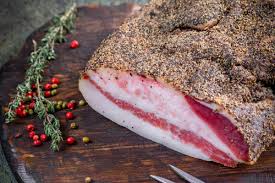
- Guanciale — Sano di Amatrice, Lazio. The cured pork cheek that carbonara, amatriciana and gricia are built on comes from Sano di Amatrice, in the Lazio town that gives Amatriciana its name. Guanciale, not pancetta, is the fat that defines this style of Roman cooking.
- Pecorino Romano DOP — Fulvi, Lazio. The cheese is Pecorino Romano DOP from the Fulvi dairy, itself recognised by Gambero Rosso. DOP — Denominazione di Origine Protetta — is a protected-origin designation, so the name guarantees where and how the cheese is made rather than being a style label anyone can borrow.
- Olive oil — Olio Sassicaia, Tenuta San Guido, Tuscany. The olive oil is Olio Sassicaia, from Tenuta San Guido in Tuscany — the same Bolgheri estate behind the Sassicaia wine.
These are the ingredients that turn up under specific dish names: guanciale and Pecorino Romano DOP in the Mezze maniche carbonara, guanciale and Pecorino in the Tonnarelli all'Amatriciana, Pecorino in the Tonnarelli cacio e pepe. The guanciale and pecorino behind the carbonara are detailed in Roman Carbonara in Lisbon.
From Italian regions to a Lisbon table
Read as a map, the pantry is not a single-region story — it is a Roman kitchen sourcing each element from the place that does it best. Pasta from Abruzzo (Verrigni) and the Marche (La Pasta di Aldo); guanciale and pecorino from Lazio (Sano di Amatrice, Fulvi); olive oil from Tuscany (Tenuta San Guido). What ties the title together is Teramo: it is where Verrigni mills its pasta, and it is where co-founder Alessandro Laganà worked in hospitality before opening in Lisbon.
For a diner deciding between Italian restaurants in a city with plenty of them, the difference here is checkable. Each producer has a name, a town and, in several cases, third-party recognition — Gambero Rosso International for Verrigni and La Pasta di Aldo, a Heston Blumenthal endorsement for La Pasta di Aldo, DOP status for the Fulvi pecorino. The Abruzzo pantry behind Il Matriciano is not a slogan on the wall; it is a supplier list you can look up.
For more on the founders and how the restaurant came together, see About / Founder Story.
Ristorante Il Matriciano — Essential Information
1200-816 Lisboa, Portugal
Dinner 19:30–23:00
Closed Sunday