Roman Cuisine · Technique · Lisbon
Why Real Carbonara Doesn't Have Cream
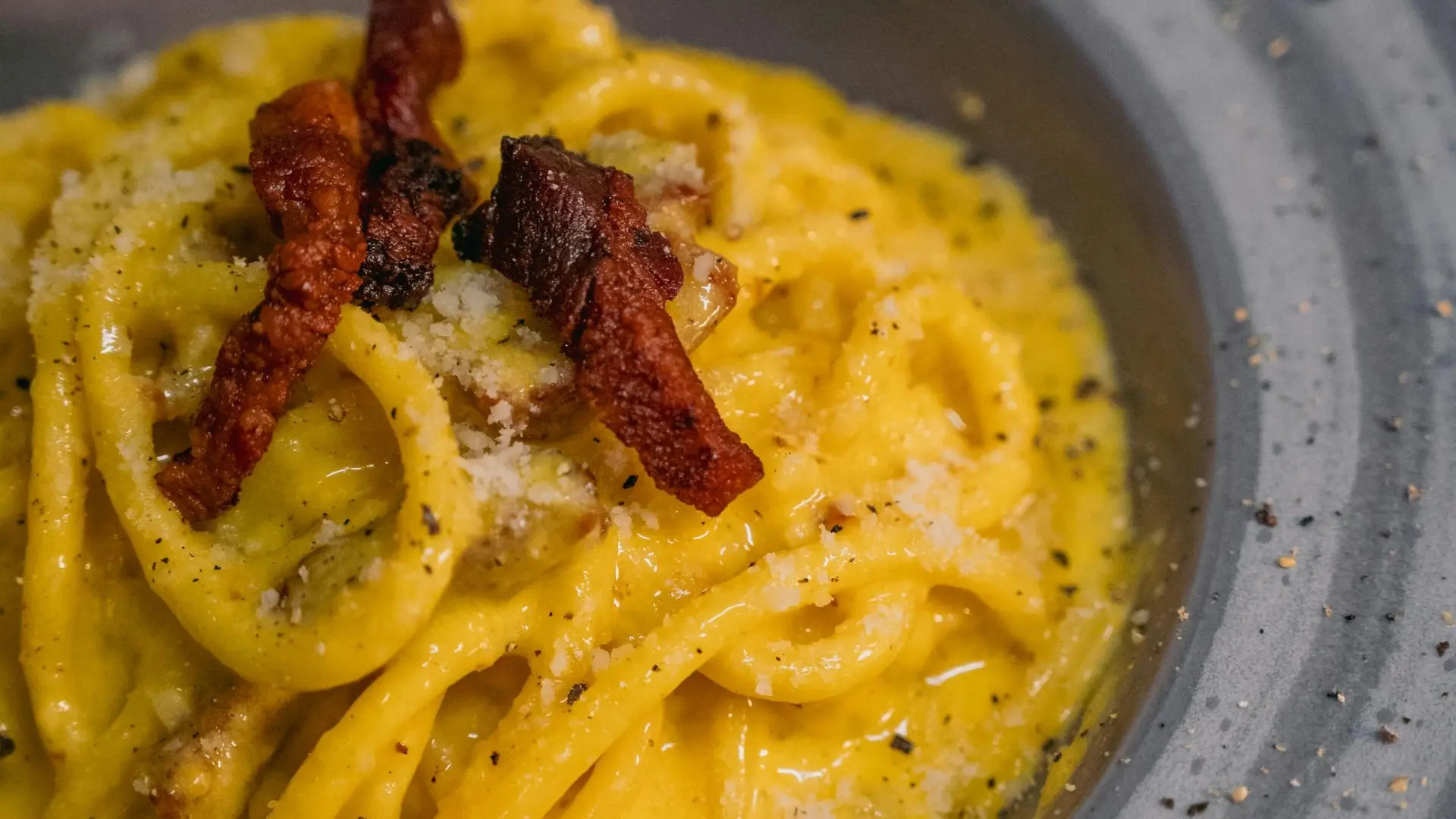
Authentic Roman carbonara is an emulsion of egg yolk and Pecorino Romano cheese, bound by the residual heat of just-cooked pasta and the fat rendered from guanciale. Cream is not in the original recipe and is not a stylistic substitution — it replaces the emulsion technique with a different sauce entirely. The original clings to the pasta. The cream version coats it.
What carbonara actually is
Carbonara is one of the four canonical pastas of Lazio — alongside cacio e pepe, gricia, and amatriciana. All four are built around the same short list of regional ingredients: Pecorino Romano cheese, guanciale (cured pork cheek), and, in three of the four, generous black pepper. None of the four includes cream.
The defining technical move in carbonara is the emulsion. Egg yolks are whisked with grated Pecorino Romano DOP and black pepper into a paste. Hot, drained pasta is tossed with rendered guanciale fat. The egg-and-cheese mixture is added off the heat. The residual heat of the pasta and the fat melts the cheese, partially cooks the yolk, and binds the whole into a single dense, glossy sauce that coats the pasta from inside its tubes and ridges.
The emulsion is unstable. Heat the pan too high and the yolk scrambles. Cool too fast and the cheese seizes into clumps. A carbonara that finishes smooth, glossy, and pourable is the result of three or four minutes of focused work inside a narrow temperature window.
What cream does — and doesn't do
Cream is already an emulsion: fat dispersed in water, stabilised by milk proteins. When cream is added to a pan of hot pasta and rendered guanciale, the cream sits on the pasta as a fluid sauce. It doesn't bind to an egg-and-cheese paste because, in the cream version, there is no egg-and-cheese paste — cream is being used in place of it.
The result is a perfectly serviceable cream sauce with cured pork in it. It is not, however, the same dish. The texture is different (a coating film versus a clinging emulsion). The flavour profile is different (rich, dairy-forward, mellow versus sharp, eggy, and pepper-driven). The technical challenge is different too — a cream sauce is forgiving; an egg-yolk emulsion is not.
This is one reason cream is often used. It is easier. It also produces a heavier, milder dish that is more familiar to diners outside Italy. But the substitution is structural, not minor. It changes the dish at the technique level.
In Visão (11 August 2021), Stefania Carpoca — who co-founded Il Matriciano with Alessandro Laganà — was quoted on this directly: the restaurant's carbonara is made "sem natas" como manda a receita original ("'without cream' as the original recipe dictates").
Why guanciale, not pancetta or bacon
Guanciale, pancetta, and bacon are all cured pork, but they come from different parts of the animal, are cured differently, and behave differently in a pan.
| Cut | Fat profile | Cure | Behaviour in pan | |
|---|---|---|---|---|
| Guanciale | Pork cheek | ~70% fat / 30% lean | Salt, pepper, sometimes herbs; no smoke | Slow, clean fat render; crisp meat edges |
| Pancetta | Pork belly | Closer to 50/50 | Salt, often rolled, sometimes smoked | Less fat render; flavour closer to bacon |
| Bacon | Pork belly | Variable | Smoked | Smoke dominates; competes with the pepper and Pecorino |
In carbonara, the rendered guanciale fat is part of the emulsion. It carries the pepper, lubricates the toss, and contributes to the glossy surface of the finished sauce. Substituting pancetta produces less fat and a leaner mouthfeel. Substituting bacon adds smoke that competes with the Pecorino instead of supporting it.
The issue isn't authenticity for its own sake. The fat ratio changes the chemistry of the sauce.
Why Pecorino Romano DOP, not Parmesan
Pecorino Romano and Parmigiano-Reggiano are both DOP-protected hard cheeses, but they come from different animals, different regions, and produce different sauces:
| Milk | Region (DOP) | Flavour | Role in carbonara | |
|---|---|---|---|---|
| Pecorino Romano DOP | Sheep | Lazio, Sardinia, Grosseto (Tuscany) | Sharp, salty, tangy | Cuts the richness of the yolk |
| Parmigiano-Reggiano DOP | Cow | Emilia-Romagna | Nutty, mellow, more umami | Softens and sweetens the sauce |
Substituted into carbonara, Parmigiano produces a softer, sweeter sauce that loses the sheep's-milk sharpness defining the original. This isn't a quality comparison — both cheeses are excellent within their own contexts. They are simply not interchangeable. Lazio cooks Pecorino. Emilia cooks Parmigiano. Carbonara is a Lazio dish.
Where the "no cream" rule comes from
Carbonara is a relatively young dish by Italian standards. Its definitive emergence is in mid-twentieth-century Rome — the dish doesn't appear in nineteenth-century cookbooks, and the historical record places it in post-war Roman trattoria culture. The exact origin story is contested; several competing accounts circulate, none with firm documentary support.
What is consistent across the historical record is that the dish was codified in Rome with Roman ingredients: guanciale, egg, Pecorino Romano, black pepper. The cream variant emerges later, in non-Roman and especially non-Italian kitchens, where it spread as an easier path to a thick sauce.
The "no cream" rule is therefore not a tradition for its own sake. It is a fidelity to the technique that defines the dish — the emulsion of yolk, cheese, and rendered fat that gives Roman carbonara its texture and balance.
How Il Matriciano holds to the rule
Il Matriciano lists the dish on its menu as "Mezze maniche with pork cheek, eggs, pecorino romano, black pepper." No cream is listed. The kitchen sources guanciale from Sano di Amatrice in Lazio — the same town that gives its name to pasta all'Amatriciana — and Pecorino Romano DOP from Fulvi dairy, also in Lazio. Fulvi's Pecorino Romano DOP is recognised by Gambero Rosso.
The mezze maniche themselves are dry pasta from Pastificio Verrigni (Roseto degli Abruzzi, Abruzzo — slow-dried at 45–50 °C for up to 72 hours, used by 3-star Michelin chefs including Massimiliano Alajmo, Massimo Bottura, and Niko Romito) and La Pasta di Aldo (Monte San Giusto, Marche — patented Metodo Aldo egg pasta, endorsed by Heston Blumenthal). Both are recognised by Gambero Rosso International. Mezze maniche is a short ridged tube — a Roman shape for carbonara, where the ridged exterior grips the emulsion and the open tube fills with sauce. More on our pasta.
A TripAdvisor reviewer noted in April 2025: "I am surprised by a very good carbonara, light and crisp" (Marco M, TripAdvisor, IT→EN). Light and crisp is what the technique produces when it works; cream produces something heavier and richer by construction.
If the four ingredients are correct and the technique is correct, the sauce works. Cream is not a shortcut; it is a replacement. A carbonara made the Roman way takes a few minutes longer and a few degrees of attention more. The result is the dish that was codified in Rome, with the texture and balance that codification built around. Read how we make it.
Ristorante Il Matriciano — Essential Information
1200-816 Lisboa, Portugal
Dinner 19:30–23:00
Closed Sunday