Roman Cuisine · Tradition · Lisbon
The Roman Pasta Tradition
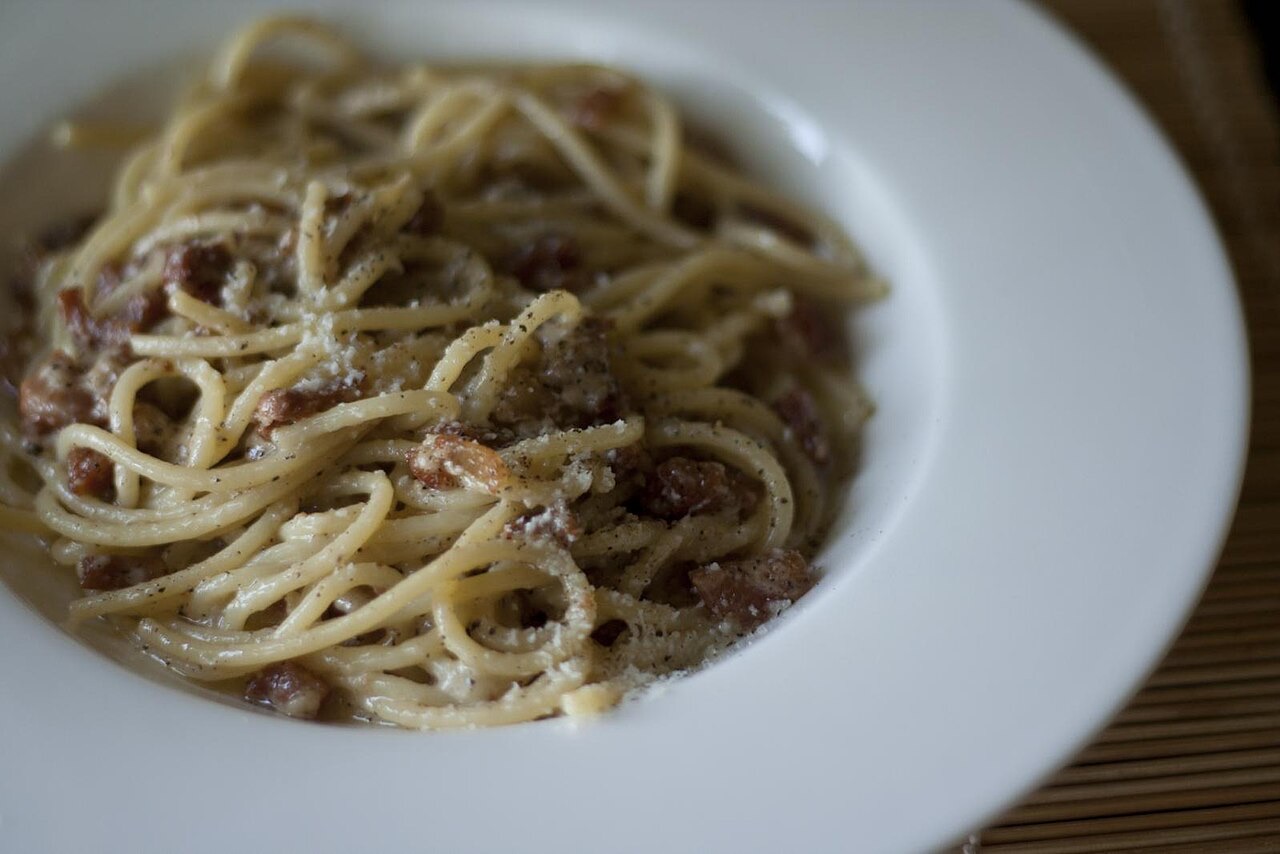
Roman cuisine is built on a quartet of pasta dishes that share the same short list of ingredients: carbonara, amatriciana, cacio e pepe, and gricia. Il Matriciano, opposite Lisbon's Parliament on Rua de São Bento, cooks this Roman repertoire with guanciale, Pecorino Romano DOP, and pasta from named Italian producers.
What makes a pasta "Roman"?
Rome's four classic pasta dishes are not four unrelated recipes. They are one family, built up from the same base. Take pork cheek, sheep's-milk cheese, and black pepper, and you have gricia. Add tomato and you have amatriciana. Add egg instead of tomato and you have carbonara. Strip the pork out and keep the cheese and pepper, and you have cacio e pepe.
That is the whole system. Two cured-pork dishes with a tomato-or-egg fork, and a meatless dish that isolates the cheese. The ingredients are humble — guanciale, Pecorino Romano, black pepper, egg, tomato, chilli — and the discipline is in the technique: the cheese has to emulsify into a sauce rather than clump, and the guanciale renders its own fat rather than being cooked in oil.
Carbonara: guanciale, egg yolk, Pecorino, pepper
Roman carbonara has four ingredients: guanciale (cured pork cheek, not pancetta), egg yolk (not cream), Pecorino Romano, and black pepper. The egg yolk and the starchy pasta water form the sauce; there is no cream in the Roman version. At Il Matriciano the dish is Mezze maniche carbonara, made with guanciale, eggs, pecorino romano, and black pepper.
We cover the technique in detail in Roman Carbonara in Lisbon and the reasoning behind the no-cream rule in Why Real Carbonara Doesn't Have Cream.
Amatriciana: guanciale, tomato, Pecorino, chilli
Amatriciana is gricia with tomato added. The dish takes its name from Amatrice, a town in Lazio, and it is the dish the restaurant is named after — "Matriciano" comes from "matriciana." The sauce combines guanciale, tomato, Pecorino Romano, and a note of chilli. On the menu it appears as Tonnarelli all'Amatriciana — tonnarelli being a square-cut, string-shaped fresh pasta close to a thick spaghetti, the traditional shape for these Roman sauces.
Cacio e pepe: two ingredients, exact technique
Cacio e pepe means "cheese and pepper," and that is the entire ingredient list: Pecorino Romano and black pepper, bound with pasta water into a glossy sauce. With nothing else to hide behind, it is the dish that most exposes the cheese and the technique — the Pecorino has to be worked into an emulsion at the right temperature or it seizes. Il Matriciano serves it as Tonnarelli cacio e pepe.
Gricia: the guanciale-and-Pecorino base
Gricia is often called the ancestor of the quartet — carbonara and amatriciana are both gricia with one addition. It is guanciale, Pecorino Romano, and black pepper, without tomato or egg. It is the plainest of the four and, for that reason, another test of the guanciale and the cheese rather than of a sauce.
Why does the pasta shape matter?
The Roman sauces are matched to specific pasta shapes, and Il Matriciano's menu reflects that. Tonnarelli — the square-cut, string-shaped fresh pasta used here for the amatriciana and the cacio e pepe — has a rough, porous surface that grips a cheese emulsion far better than a smooth machine spaghetti. Mezze maniche, the short, wide tubes used for the carbonara, are hollow, so they trap sauce and pieces of guanciale inside as well as out. The shape is not decoration; it is part of how the sauce clings to each forkful.
Which of these can you order at Il Matriciano?
Il Matriciano's menu lists three of the four canonical Roman pastas:
- Tonnarelli all'Amatriciana — guanciale, tomato, chilli
- Tonnarelli cacio e pepe — Pecorino Romano and black pepper
- Mezze maniche carbonara — guanciale, eggs, pecorino romano, black pepper
Gricia does not currently appear on the online menu. The three listed dishes cover the tomato branch (amatriciana), the egg branch (carbonara), and the meatless base (cacio e pepe) of the Roman family.
Where the ingredients come from
The Roman quartet stands or falls on two ingredients, and both are sourced from named producers. The guanciale comes from Sano, in Amatrice (Lazio) — the same town amatriciana is named after. The Pecorino Romano is DOP (Denominazione di Origine Protetta, the Italian protected-origin designation) from the Fulvi dairy in Lazio, a producer recognised by Gambero Rosso International.
The pasta itself comes from two Italian producers rather than a generic supplier: Pastificio Verrigni, in Roseto degli Abruzzi (Abruzzo), and La Pasta di Aldo, in Monte San Giusto (Marche) — both recognised by Gambero Rosso International. More on the pasta in Fresh Pasta in Lisbon.
The short version
The Roman pasta tradition is a small, precise repertoire: four dishes built from guanciale, Pecorino Romano, black pepper, and a fork between tomato and egg. Il Matriciano cooks three of the four — amatriciana, cacio e pepe, and carbonara — with guanciale from Amatrice and Pecorino Romano DOP from Fulvi. For the technique behind the most-asked-about of them, read Roman Carbonara in Lisbon.
Ristorante Il Matriciano — Essential Information
1200-816 Lisboa, Portugal
Dinner 19:30–23:00
Closed Sunday